STAGES9 min read
Digital Twin in Facility Management - when handover is only the beginning (and how STAGES preserves the building’s truth)
Facility management is rarely one big project. It is hundreds of small decisions that add up to reliability: an issue that needs diagnosis, an audit that needs proof, a renovation that cannot rely on guesswork, a contractor who needs context without pulling your team into yet another round of site walks. The challenge is that the building changes, people rotate, vendors come and go, and the most valuable knowledge starts to fragment.
That is why “Digital Twin in Facility Management” is shifting from a buzzword to a practical way to regain control. A useful FM digital twin is not just a 3D view. It is a living record of what exists, what changed, and which decisions were made - tied to the places where work actually happens. STAGES is built around that idea: one continuous digital record of your facility, (opens in a new tab) connected over time.
In this article, you will see how a digital twin reduces day-to-day operational chaos and how STAGES uses reality capture (opens in a new tab), timeline-based work, and collaboration tools to keep building knowledge usable for maintenance, audits, and renovations.
The core FM problem: the building has a memory, but your tools do not
A facility never stands still. Spaces are reconfigured, systems are serviced, upgrades happen in stages, and parts of infrastructure disappear behind finishes. Documentation, meanwhile, becomes outdated the moment it is exported and filed away. At the same time, a facility manager’s responsibilities do not slow down - you still need to maintain uptime, control risk, ensure compliance, and prove what happened, when, and why when questions arise.
Most FM teams do not struggle because they are not working hard enough. They struggle because they lack continuity. The handover package is often treated as a finish line, but operations last for decades. Every year without a reliable historical record increases the cost of diagnosis, the number of repeat visits, and the risk of mistakes. STAGES is positioned against that pattern by emphasizing a living building history - not static files.
The takeaway is simple: when history is disconnected, every incident becomes a small research project.
What hurts most in day-to-day facility management - and why it keeps repeating
Documentation is everywhere, which means it is effectively nowhere
FM work depends on context: what was installed, when it was modified, what was approved, and what the “before” condition looked like. In reality, that context is spread across shared drives, PDFs, emails, and vendor portals. The outcome is predictable: time lost searching, decisions made with partial information, and then rework and escalations.
STAGES is designed to make building documentation quickly accessible in a browser while also letting teams return to construction history during maintenance and renovations. In FM terms, this is the difference between acting and searching before you can act.
“Where exactly is it?” can double the impact of an incident
In a failure, the slowest step is often not the fix - it is locating the right element and understanding what changed since the last intervention. If knowledge lives in one person’s head, response time depends on who is on shift. If it lives in old emails, response depends on whether someone finds the right thread.
A digital twin matters when it provides visual truth and lets you reconstruct it over time. STAGES supports this by working with stages and allowing teams to check past conditions in a consistent spatial context. That turns guessing into verification.
Audits and inspections require proof, not explanations
Audits rarely come down to “are you doing anything?” They come down to “show the evidence.” When evidence is scattered, audits become stressful and expensive because the team is collecting traces instead of operating. STAGES is positioned to help teams approach audits and inspections with greater confidence by relying on documented proof inside the building’s history.
Renovations create risk twice - during work and after walls close
In FM, hidden conditions are the worst kind of uncertainty. Systems changed during upgrades can disappear behind finishes, and months later, a ticket shows up, and the team is forced into a lottery: where exactly is it, how was it routed, what was moved. Without stage comparison, the risk of destructive checks, wrong assumptions, and avoidable cost rises.
STAGES addresses this by enabling stage comparison and spotting differences between “then” and “now.” In FM terms, that shortens the investigative phase and reduces blind work.
Handover between teams and vendors drains efficiency
Even a well-run facility loses momentum when vendors change, teams rotate, or a renovation transitions into operations. Without shared context, every change of people resets knowledge and forces another round of explanation. STAGES is designed to reduce that friction by supporting smoother handover between teams and contractors through a shared building history.
The problem is not the number of tasks - it is that tasks disappear in communication
A facility manager does not need another to-do list disconnected from the physical space. They need a workflow where the issue and the conversation stay tied to the location and evidence. Otherwise, communication degrades into messages like “it is probably in that part of the building,” and then someone goes to the wrong place or completes the wrong work. STAGES supports a model where the problem stays anchored in the building context, and the follow-up remains visible across stakeholders.
What a digital twin must do to be useful in FM - not just visually impressive
A digital twin in facility management (opens in a new tab) is only useful if it meets three conditions. First, it provides continuity across time - because FM manages a building that evolves. Second, it enables comparison - because many decisions depend on “what changed” and “what is behind this surface.” Third, it supports collaboration in context - because FM is a team sport, often involving external contractors.
STAGES maps those needs to a clear logic: a building timeline, stage comparison, and collaboration tools anchored in the digital twin. In FM terms, that is what makes a digital twin practical - a working system that shortens the path from problem to decision.
How STAGES turns FM pain into an executable process
Timeline - when the building has memory, not just files
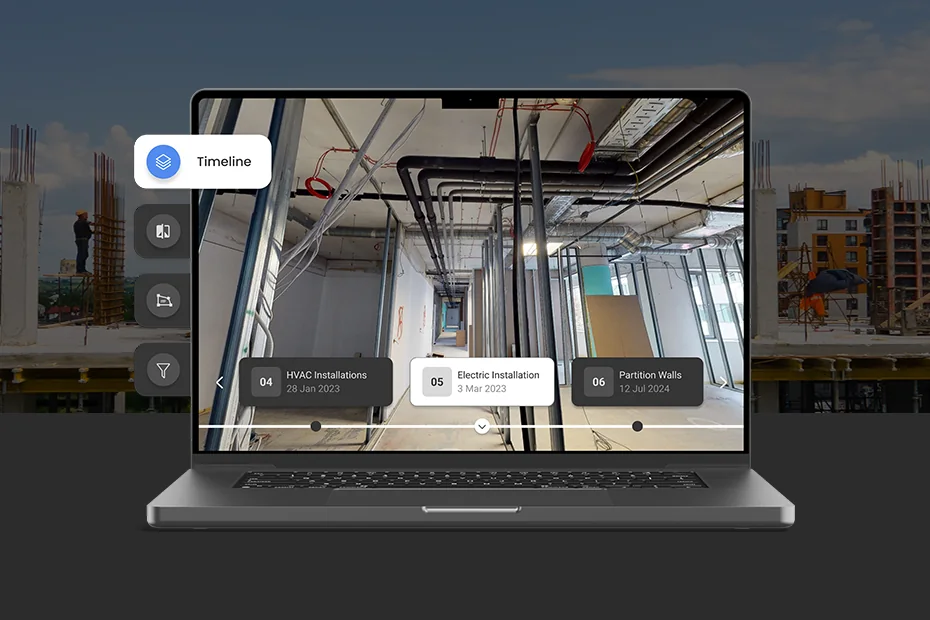
From an FM perspective, the biggest enemy is the lack of chronology. When it is unclear which documents reflect which phase, every analysis carries risk. STAGES uses a timeline approach (opens in a new tab) that helps organize building stages and move between them while keeping orientation and context. For FM teams, this means an incident or audit does not start with “where is the latest file?” but with “which stage shows this condition - and what came before it?”
Split screen - when the difference between stages becomes obvious immediately
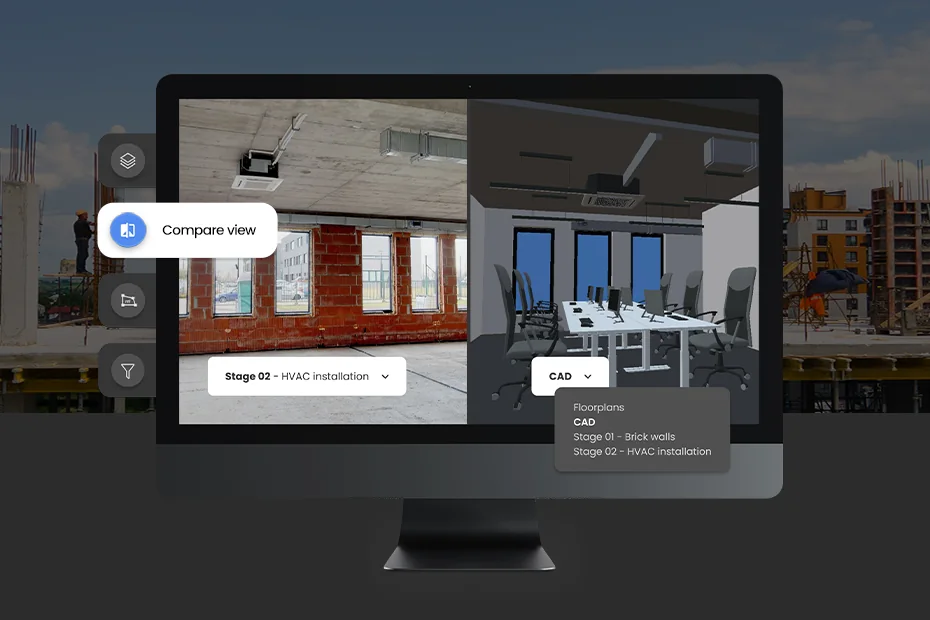
In facility operations, many issues are differences, not single states. Something was routed differently, something became concealed, something disappeared from view. Side-by-side stage comparison (opens in a new tab) resolves that uncertainty: instead of debating “how it used to be,” you can check. As a result, the number of costly visits and unnecessary checks drops, and decision confidence increases.
Notes and reporting - when communication stays attached to the location
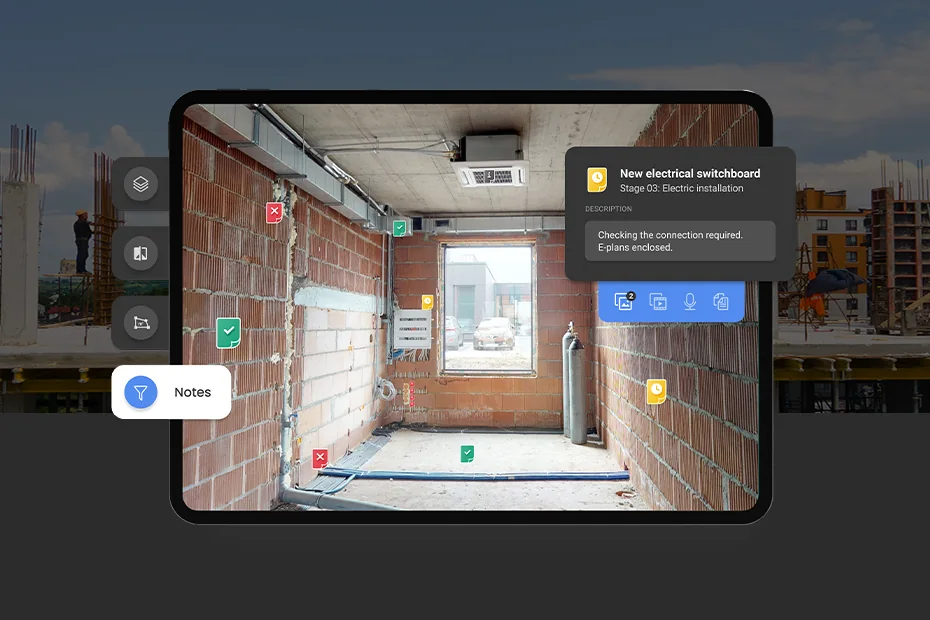
In FM, communication without spatial context naturally degrades over time. Chaos appears: someone misinterprets, someone adds assumptions, someone loses details, and the issue returns to your desk as an escalation. STAGES supports a workflow where the issue is anchored to the place (opens in a new tab), enriched with evidence, and its status remains visible. That closes the loop from “I see it” to “I document it” to “I hand it over” to “I verify resolution” within a single consistent context.
Access control - when multiple parties need the same truth
Facility management is a balance between collaboration and security. Contractors need context, compliance needs order, and ownership needs control over what is shared. STAGES supports an approach that allows access and permissions to be managed so that different parties see only what they need without exposing everything.
What this looks like in real FM situations
Picture a scenario that repeats across thousands of buildings: a ticket arrives, but the facility has gone through multiple upgrades, and no one is sure what the hidden condition looks like. In a typical workflow, the team walks the site, calls a few people, searches old email threads, and often ends up with an extra visit just to confirm. In a digital twin workflow, you review historical context, compare the stage, document the issue in place, and then hand it to the vendor in a way that prevents them from repeating your investigation.
The second scenario is an audit. The most expensive part is usually gathering evidence and aligning everyone on what is current. When documentation is tied to the building’s history and spatial context, it becomes easier to present a coherent story: what existed, what changed, and what evidence supports it.
The third scenario is renovation. STAGES presents an approach where building history and stages allow teams to analyze conditions before, during, and after renovation without repeating site visits just to “see what is happening.” For FM, that means less operational disruption and fewer decisions made on intuition.
How to start with STAGES without an overwhelming rollout
The most effective FM rollouts do not start with a massive program. They start with one facility and one concrete pain point. First, you establish an organizational environment that lets you invite the team and set access rules. Then you launch a project and connect the first as-built capture to create a baseline. Next, you add stages, and your day-to-day work shifts into a consistent loop: check historical context, compare stages, document the issue in place, hand off to a contractor, and keep the evidence trail intact.
If you also need advanced engineering data, you can extend the workflow with the desktop app (opens in a new tab), which supports broader format compatibility and data synchronization into the timeline.
Try for free and start with one project and one repeatable process, such as issue handling or audit readiness. If you need a portfolio rollout and governance, choose Contact sales.
Learn more about how to start with STAGES: https://sim-stages.com/support-center/first-steps/how-to-start-work-with-stages/ (opens in a new tab)
FAQ
Is STAGES relevant after handover, or is it only for construction?
STAGES is positioned for the long life of a facility, including operations and maintenance. The core idea is access to building history and documentation when FM needs it most, during maintenance and renovations.
What is the difference between a 3D model and a Digital Twin in Facility Management?
A 3D model shows the space. A digital twin in FM supports decisions: it preserves change history, enables stage comparison, and keeps evidence and communication tied to place and time. That is the difference between viewing and operating.
How do we compare building stages for maintenance work?
Comparison is critical in FM because many issues come from differences across phases. The STAGES approach is built around comparing stages to quickly verify what changed in a specific location.
How do we report issues so vendors do not need repeated clarification about location?
The advantage of communication anchored in a digital twin is that the issue stops being a description and becomes a location-based reference. That reduces questions, misinterpretations, and repeat visits.
Can we share with external contractors safely?
Yes, when the platform supports access control and controlled sharing. In FM, this is essential because collaboration cannot mean losing governance.
Is the web version enough, or do we need the desktop app?
Web is the natural choice for collaboration and access from different devices. Desktop is helpful when you work with more advanced data and need broader format compatibility.
A short summary
Facility management breaks down when the building’s truth is scattered and teams are forced into shortcuts because there is no time to reconstruct context. Digital Twin in Facility Management only matters when it connects change history, stage comparison, and communication to the place where work happens. STAGES is built around that workflow logic - so building knowledge stays alive and usable.